Periodically, my students remind me why I believe the future is not as dismal as it is sometimes portrayed. Over the years, I have observed students transforming ideas from simple conversations into tangible realities. However, this semester, I was particularly impressed by my Digital Public Relations students at UniMAC (University of Media Arts and Communications).
As part of their course project, I challenged them to establish a business from inception and to apply all their knowledge of Digital Public Relations to animate that enterprise.
They did not merely create hypothetical companies. They endowed their organizations with a mission, vision, brand voice, and personality. They developed three, and in certain cases four, social media platforms dedicated to public education, corporate communication, and community engagement.
Subsequently, the focus shifted to personal branding. Each student was required to create a LinkedIn profile, articulate a personal brand statement, identify an area of expertise related to their group project, and demonstrate thought leadership through original content. They devised a two-week content and storytelling campaign, which included: A customer or community success story, an educational post, a short video or reel, a 500-word blog article, a content calendar and a clearly defined target audience and buyer persona.
They identified influencers and mobile marketers for their businesses. They learnt to monitor and evaluate digital campaigns using metrics such as reach, followers, engagement, and other indicators. Then I threw a crisis at them.
They had to create a crisis and apply Digital PR principles to manage it. They had to consider reputation, communication, response and recovery. They also worked on Search Engine Optimisation, asking themselves: “How do we make sure people can actually find this business?”
Then came ethical dilemmas in the digital age. They had to confront difficult situations, make decisions and justify them ethically. Finally, they explored emerging technologies and considered how these technologies could shape the future of their businesses.
However, what impressed me most was not the sheer number of tasks they accomplished. It was the quality and impact of their work. I observed innovative business ideas with the potential to develop into viable enterprises. Several students extended their efforts beyond the classroom, engaging in fieldwork to test, validate, and develop their concepts.
Subsequently, the students delivered their presentations. They stood before their colleagues to defend their business decisions. Their coursemates challenged them, questioned their strategies, and encouraged them to think differently. This, in my view, exemplifies education. It transcends merely passing examinations and involves cultivating an environment where young individuals can think critically, experiment, experience failure, defend ideas, reevaluate them, and ultimately create innovative solutions.
Consequently, I am convinced that the future is not bleak. As an adjunct lecturer, I do not celebrate solely because my students have completed their projects; rather, I celebrate because, year after year, I observe evidence of creativity, resilience, innovation, and entrepreneurial spirit among our youth. Furthermore, this is not exclusive to my students. Across UniMAC, educators are assigning projects that necessitate students to move beyond theoretical knowledge and apply their learning to real-world challenges. I have witnessed instructors go above and beyond to prepare their students for a rapidly evolving workforce.
Our young people have ideas. They have creativity. They have the capacity to build. What they require is guidance, mentorship, resources, opportunities, and an environment conducive to the nurturing of those ideas.
Envision the possibility of some of these classroom projects evolving into actual businesses. Imagine if a student who currently has a business idea on paper eventually employs five people, then ten, then fifty.
One possible approach to alleviate pressure on the job market and decrease the number of young individuals lacking opportunities is to consider not only preparing young people to seek employment but also to empower them to create employment opportunities. This strategy advocates for a dual focus: equipping youth not merely to search for jobs but to foster entrepreneurial initiatives.
So, to my students and to the many young people across Ghana who are creating, experimenting and dreaming: Keep building. Your idea may seem small today, but it could become someone’s livelihood tomorrow.
And to lecturers, educators, mentors and institutions: let us continue to give our young people the opportunity to create, not merely to consume knowledge.
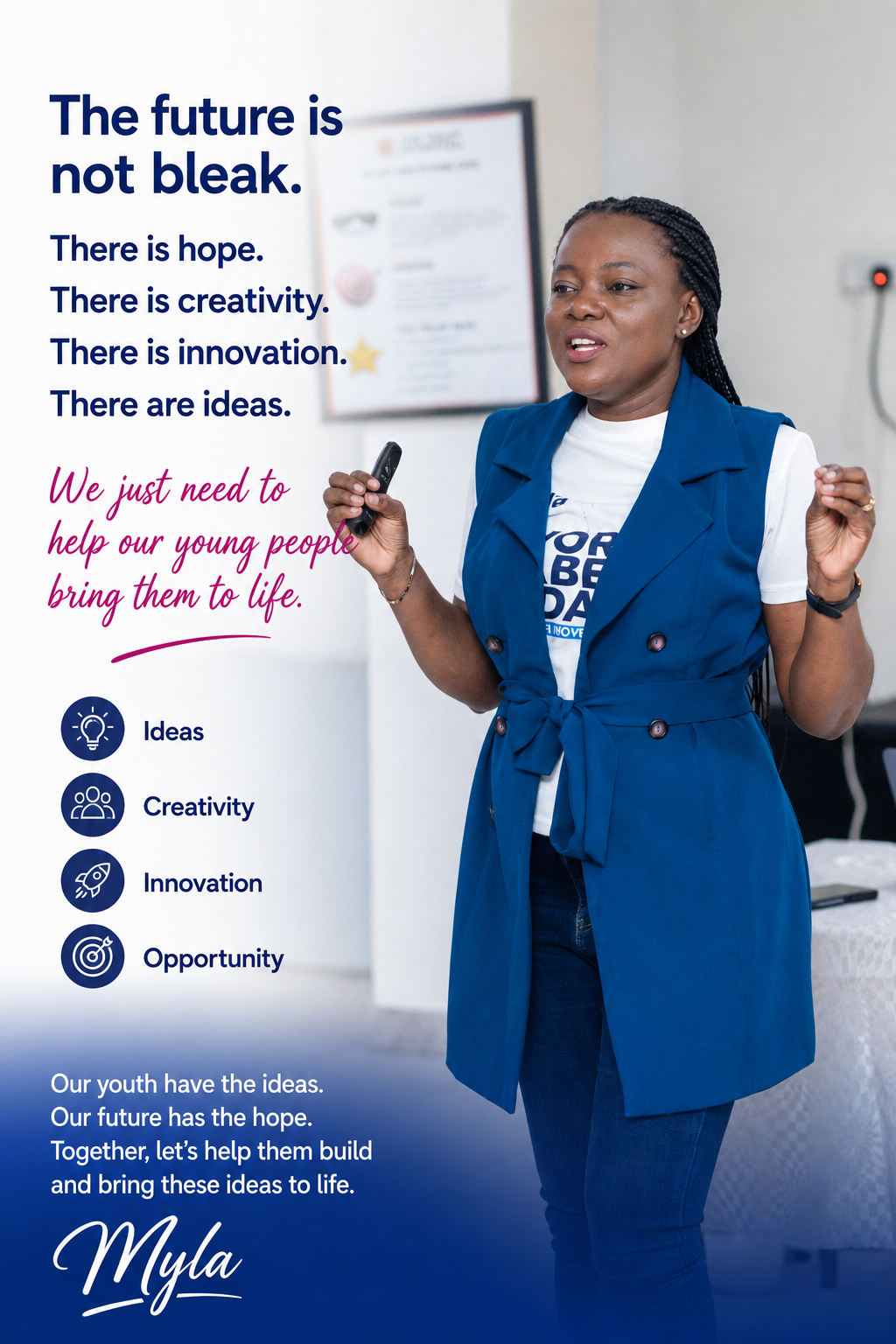
Because when I look at what these young people are producing, I am convinced of one thing: The future is not bleak. There is hope. There is creativity. There is innovation. There are ideas. We just need to help our young people bring them to life.
By: Mary A. Lawson