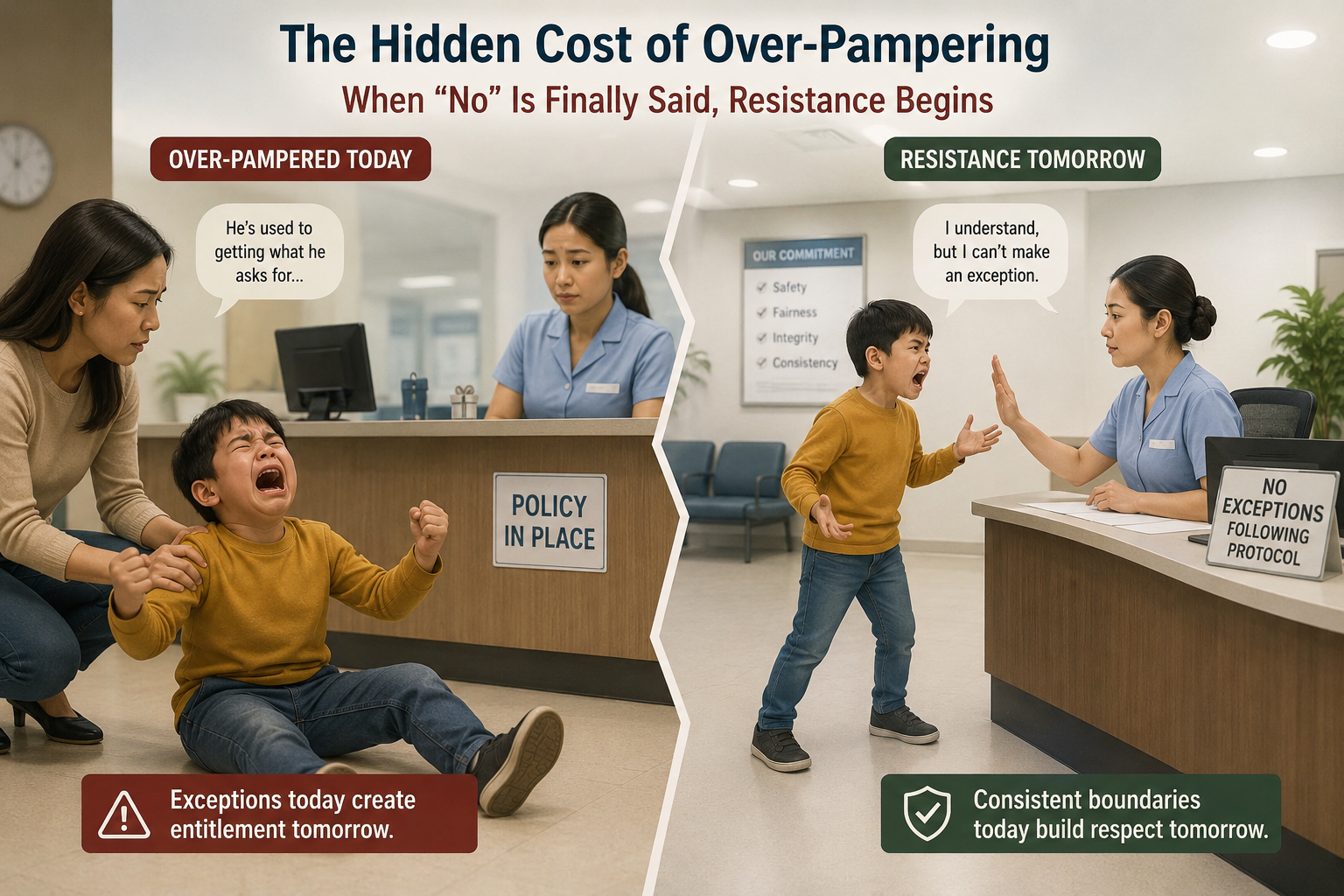
Every parent or guardian recognises this scenario. A child is raised in an environment where rules are flexible, boundaries are blurred, and exceptions are made out of love. Bedtimes are negotiable. Discipline is inconsistent. Requests are granted simply to avoid discomfort or conflict.
For a while, everything seems fine, peaceful, even. But the moment structure is introduced when the parent finally says “no” and means it, the reaction is immediate. Resistance. Complaints. Emotional outbursts. The child does not see this as a correction; they see it as unfairness. Not because the rule is wrong, but because it came too late.
In healthcare settings, the instinct to help is even stronger. Staff are trained to care, to empathize, to go the extra mile for patients in distress. But when this care extends into routinely bending protocols, a similar pattern emerges.
A patient is allowed to:
- Delay payments outside policy
- Bypass standard procedures
- Receive special accommodations not available to others
Initially, this builds goodwill. The patient feels valued and supported.
But over time, these exceptions quietly become expectations. So when the facility eventually enforces its protocols whether for billing, clinical safety, or operational reasons the reaction mirrors that of the undisciplined child:
- “Why is this suddenly a problem?”
- “But you allowed it before.”
- “Your service has dropped.”
What is actually happening is not a decline in service but a return to structure.
This dynamic is not limited to homes or hospitals; it is deeply embedded in organisational behaviour.
Leaders who constantly accommodate staff outside policy, overlooking lateness, excusing underperformance, or creating “special cases” often face backlash when they attempt to restore discipline.
Employees who were once indulged begin to:
- Challenge authority
- Resist accountability
- Perceive fairness as hostility
Again, the issue is not the rule, it is the inconsistency of its application.
Therefore, whether in parenting, healthcare, schools, or corporate environments, protocols are not obstacles; they are stabilisers.
They exist to ensure:
- Fairness: Everyone operates under the same expectations
- Safety: Particularly critical in healthcare and education
- Clarity: Reduces ambiguity and emotional interpretation
- Sustainability: Systems can function efficiently without constant exceptions
When these structures are upheld consistently, they prevent the confusion and entitlement that lead to conflict later.
There is a difference between genuine excellence and unsustainable indulgence. When protocols are repeatedly broken to accommodate individuals who appear to need “extra help,” the long-term consequences include:
- Entitlement Culture: What was once a favour becomes a perceived right.
- Reputational Risk: When boundaries are enforced, those affected may publicly criticise the institution, framing standard procedures as poor service.
- Operational Inefficiency: Staff spend more time managing exceptions than delivering consistent service.
- Expensive Corrections: Reintroducing discipline often requires retraining, stricter enforcement mechanisms, and sometimes even crisis communication to manage backlash.
In essence, the cost of fixing a broken system is always higher than maintaining a structured one.
This, however, does not suggest that empathy should be removed. On the contrary, compassion is essential but it must be structured. It means:
- Applying policies consistently while communicating them clearly
- Allowing exceptions only within defined, controlled frameworks
- Avoiding emotionally driven decisions that create long-term precedents
Because true professionalism is not measured by how often you say yes, but by how well you maintain fairness, integrity, and trust even when saying no.
The parent who delays discipline creates a child who resists it.
The hospital that over-accommodates creates patients who challenge it.
The leader who over-indulges creates a team that questions authority.
Across every context, the lesson is the same: Boundaries set early prevent conflict later. It may feel uncomfortable to enforce structure from the beginning, but it is far less costly than trying to rebuild it after expectations have already been distorted.